
InvITs explained

What are InvITs?
Infrastructure Investment Trusts (InvITs) are investment vehicles that pool money from investors and use it to build and operate large infrastructure projects such as toll roads, power transmission lines, or telecom towers. Just like mutual funds collect money to invest in shares or bonds, InvITs collect money to invest in infrastructure assets that generate steady income over time. In return, investors earn through dividends and capital appreciation.
How do InvITs work?
An InvIT acts as a trust that raises money from investors and uses those funds to buy or build long-term, income-generating assets. The income is distributed to retail investors who can earn in the form of dividends and capital appreciation.
InvITs can be categorized in two ways:
By sector – Energy, Transport & Logistics, Communications, Social & Commercial Infrastructure, and Water & Sanitation
By accessibility – Public-listed InvITs are listed on stock exchanges (like NSE or BSE), as exchange-traded investments (ETFs) and are accessible to retail investors. InvITs that are privately held are accessible only to select investors and cannot be traded publicly.
Who are the key players in an InvIT?
The three main entities in an InvIT are:
Sponsor – The sponsor is the company or developer that creates the InvIT. They usually own the infrastructure assets initially and then transfer them to the trust. For example, a road developer might set up an InvIT and contribute its toll roads to it.
Investment Manager – This team manages the day-to-day operations and makes key business decisions. They ensure the assets are performing well, the cash flows are steady, and new investments are strategically sound.
Trustee – The trustee is the guardian of investor interests. They make sure that the InvIT follows all regulations, maintains transparency, and protects investors from mismanagement.
How are InvITs governed?
InvITs are regulated by SEBI.
As per SEBI regulations, InvITs are mandated to invest at least 80% of their assets in completed, revenue-generating properties. They must distribute at least 90% of their net distributable cash flows to unitholders annually.
InvITs are required to have:
- An independent trustee and professional valuers
- At least 50% independent directors on the board,
- Regular asset valuation and disclosure requirements.
How do I invest in InvITs?
Retail investors can invest in publicly listed InvITs. They are listed on the NSE and BSE, and you can buy or sell their units just like shares using your demat account. They often launch through an Initial Public Offering (IPO) after which trading happens in the open market. Any resident or non-resident Indian can invest in InviTs.
What are the tax implications for a retail investor?
As a retail investor invested in InvIT, you are taxed in the following manner:
Dividend Income – If the underlying infrastructure company (called the SPV – Special Purpose Vehicle) is under the old tax regime, dividends distributed by the InvIT are completely tax-free for investors. However, if the SPV opts for the new tax regime, then there’s a 10% withholding tax on dividends.
Interest Income – Interest distributed by the InvIT is taxable in the hands of investors. For resident investors, the withholding tax is 10%. For non-resident investors, it’s 5%, subject to double taxation treaties.
Loan Repayment from the SPV – If an InvIT repays part of its internal loans to investors, that amount is not taxed immediately but it is adjusted against the cost of acquisition of the InvIT units. This means when you sell your units later, your capital gains may be slightly higher.
Capital Gains – If you sell within 36 months, it’s a short-term capital gain taxed at 15%. If you sell after 36 months, it’s a long-term capital gain (LTCG) taxed at 10% on gains exceeding ₹1,00,000.
The taxation rules are slightly tricky when it comes to adjustment of loan repayments to cost of acquisition. It is important to ensure you calculate and pay the right tax amount to ensure compliance.
Should I invest in InvITs
Here is a comparison of three InvITs, their key features and their performance:
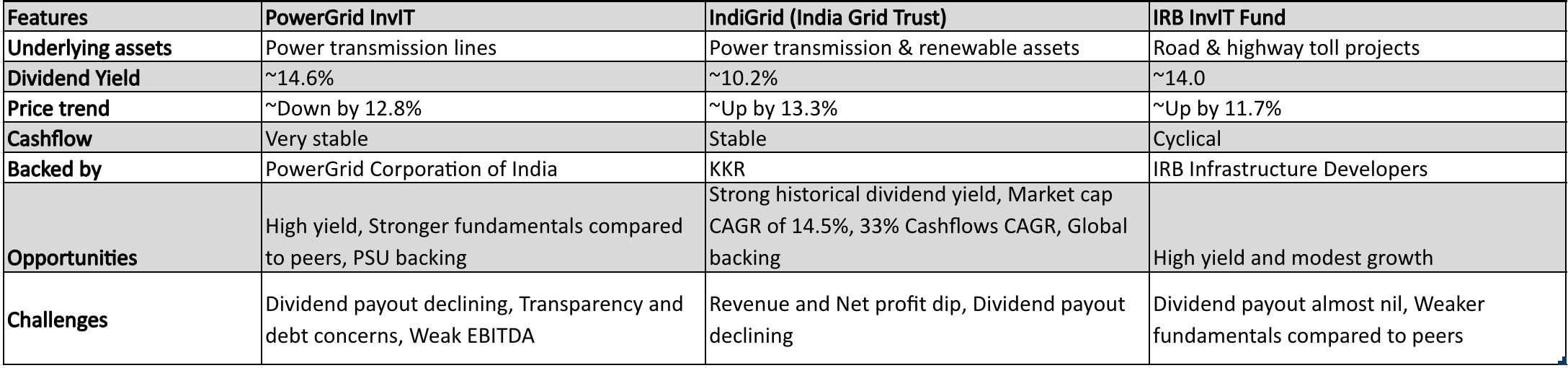
InvITs can add diversification to your portfolio and have the potential for providing steady income. They are suitable long-term investors who are comfortable with moderate risk and have limited liquidity requirements.
However, they are not a substitute for equity or debt. With issues of low liquidity, lack of enough information, taxation challenges, it might be a hassle to invest in them. You can take the route of investing in mutual funds that invest in InvITs for exposure to the commercial infrastructure sector.